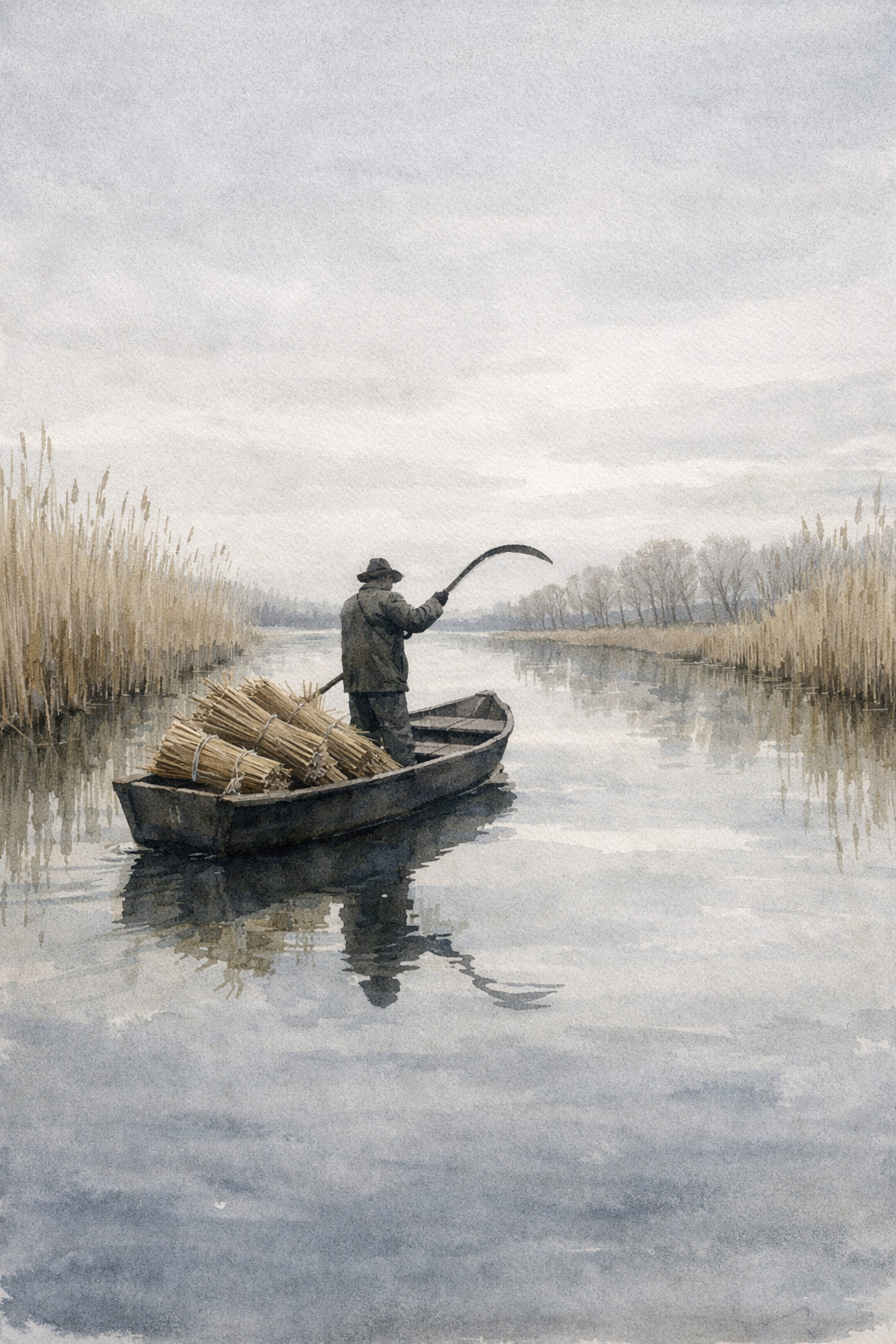
Ion Dima left Mila 23 before the light came up.
The village was behind him in the dark: the white walls and the siniliu-painted doors and window frames, the low reed-thatched rooflines invisible against the pre-dawn sky. He had loaded the lotcă the evening before — the târpan wedged under the forward thwart, the coiled binding rope, the pole for the shallow channels, the thermos of tea wrapped in the canvas bag beneath the stern seat. The boat was his father's boat, built in Tulcea twenty years ago, flat-bottomed and narrow, four metres long, its hull riding close to the water when loaded and closer still when the reed was stacked in it. He cast off the mooring line and pushed out from the bank.
Mila 23 sat on the old Sulina arm fifty-three kilometres from Tulcea, and the name came from its position: the twenty-third nautical mile along the old Sulina channel from the open sea, measured in the system the river pilots had used before the main channel was shortened and straightened for navigation. The village was accessible only by water. There was no road. The supply boat from Tulcea came twice weekly, and what the supply boat did not bring, the village made or grew or caught. It was a village of four hundred people in houses that had stood since the eighteenth and nineteenth centuries, most of them built in the Lipovan way: stone foundations, adobe walls, reed roofs, the whole painted white with the ultramarine blue — the siniliu — applied to every door and window frame and the decorative carved wooden frieze under the eaves.