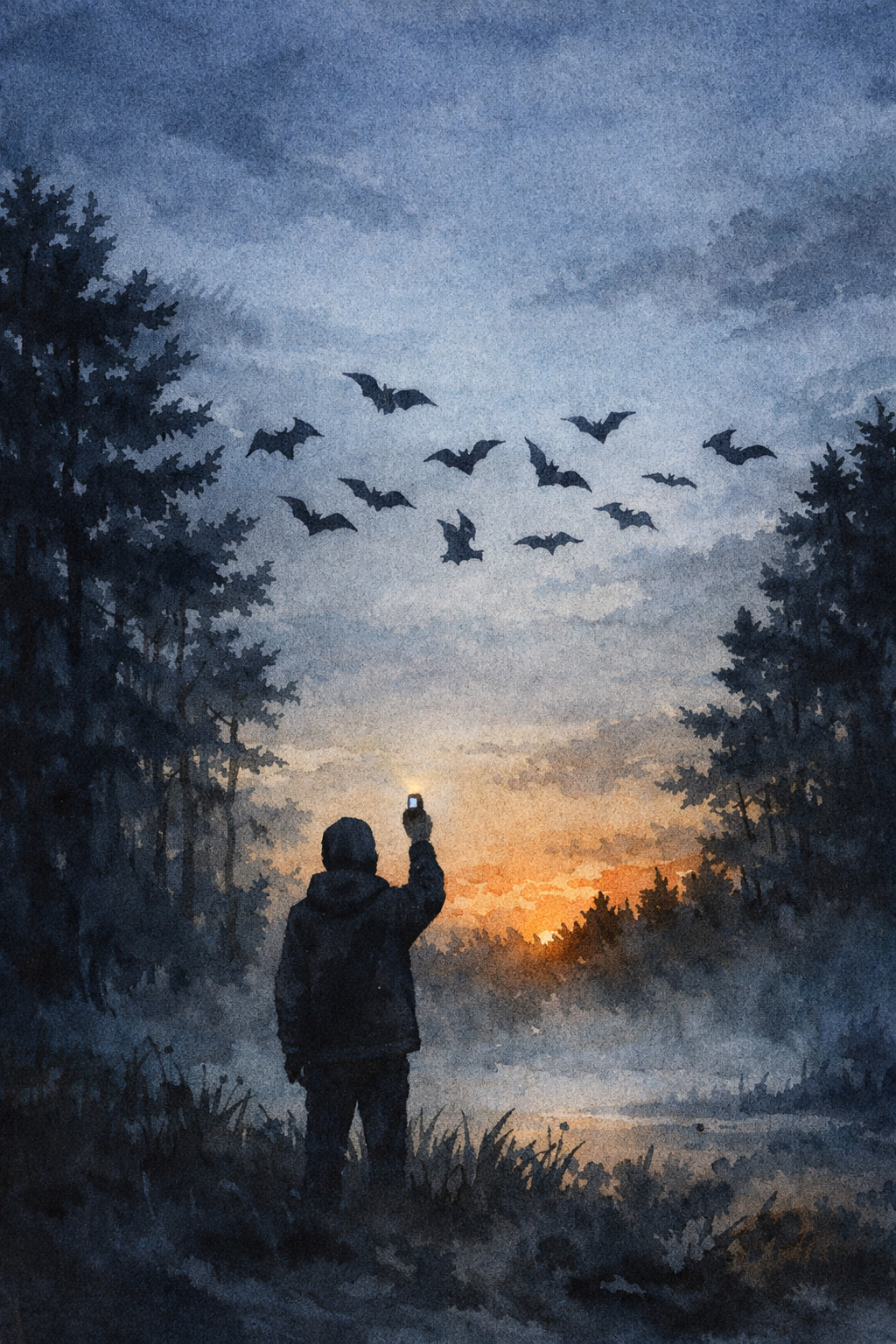
Helen parked at the field gate at eight-fifteen, twenty minutes before civil twilight.
She sat in the car and completed the weather log before she got out. Air temperature sixteen degrees — warm for August, the kind of evening that produced good activity. Wind: Beaufort one, near calm, occasional light movement in the upper canopy. Cloud cover forty percent, the sky still partly blue in the west. No rain. These were ideal conditions. She had surveyed in worse — in twelve-degree wind-chill with a headtorch and a waterproof notepad, the bats still flying because bats flew in conditions that made the surveyor miserable — but this evening would be comfortable.
She wrote the site code at the top of the form: CHP-03. Chappell's Wood, survey three of four for the season. She had walked this transect in May, in June, and now in August. The fourth survey would be in October, before the bats entered torpor.
The monitoring form was a standard transect form printed each spring by the bat group's recording coordinator — two-sided on A4, the front holding the environmental data fields and the pass count table, the back holding the transect map and a notes section for exceptional records. She had been filling in forms like this for fifteen years. She had started with a borrowed detector and a borrowed site, going out with a more experienced member of the group on someone else's transect, standing behind him and watching how it was done. The method was simple in outline and exacting in practice: the same points, the same season, the same conditions, every year.