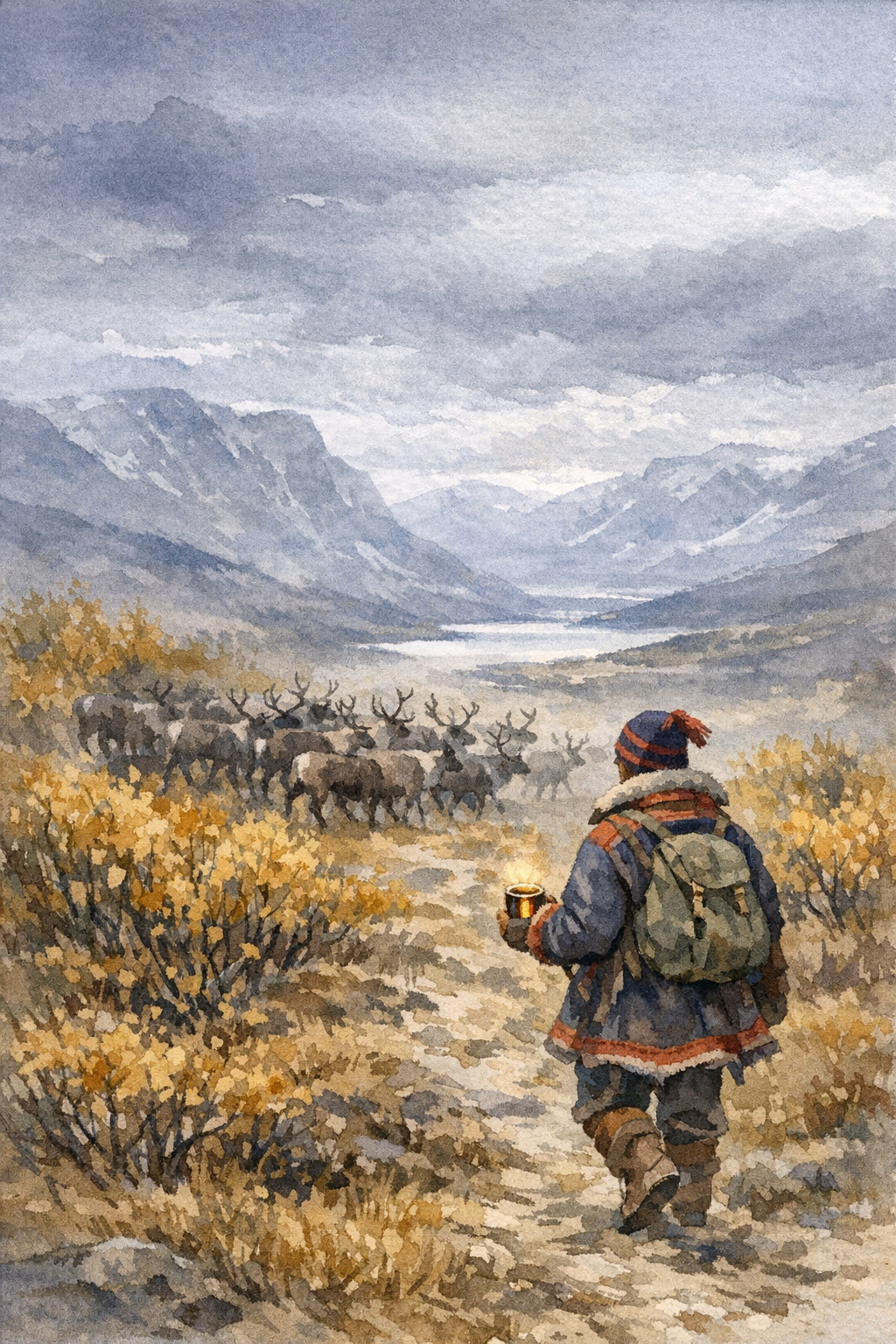
Aslak woke to the sound of the wind dropping. The tent fabric had been pulling and releasing against its poles through the night, and the sudden stillness was what brought him fully awake. He lay still for a moment and listened. Nothing moved outside. The air against his face was cold.
He drew his arm from the sleeping bag and found his watch on the groundsheet beside him. Quarter past four. Nearly an hour before the light would be any use.
He dressed in the dark without hurrying. The gákti went on first — the long tunic with its band of red and yellow braid at the collar and cuffs, worn soft from many seasons of this work. He had been given this particular gákti by his father on the morning of his first solo drive, fifteen years ago, and it had the fit now of something made for him specifically rather than passed down. He pulled on the thick trousers, the heavy woollen socks that came up over the knee, the felt-soled boots with their upturned toes. He worked by touch. He had dressed in this tent in the dark many hundreds of times and everything was where it had always been.
He folded his sleeping bag into its sack and set it along the rear wall of the tent. His pack sat by the entrance, buckled shut. He had loaded it the evening before with care — the food in one sack, the spare socks and the rain gear in another, the notebook and his tools near the top where he could reach them without opening the pack fully. He checked the main flap by feel and moved on.